0086-592-5566387
 enquiry@ticarehealth.com

We serve all people who pursue high quality and personal customization for healthy life all over the world .
Categories
Latest blog
Tags
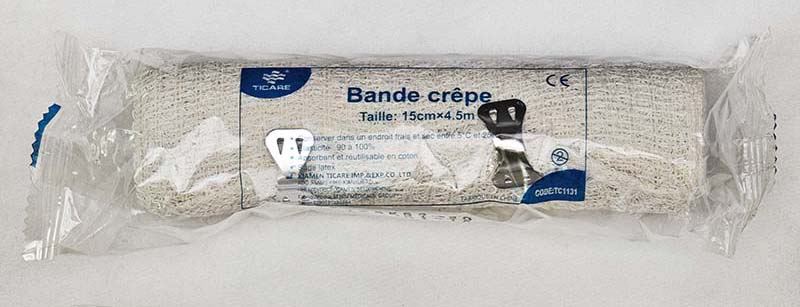
When sourcing medical crepe bandages from China, US distributors and importers often receive supplier quotations, product specifications, certificates, and FDA registration information. However, these documents alone do not establish whether a crepe bandage manufacturer is a suitable long-term wholesale partner.
Supplier qualification requires a broader assessment. Buyers need to understand the product's intended use and applicable FDA requirements, verify relevant registration and listing information, review quality documentation, and evaluate how the supplier manages product specifications and order commitments.
This is particularly important for buyers handling bulk purchases, repeat orders, and private-label projects. This guide presents a practical framework for evaluating Chinese crepe bandage suppliers and making more informed sourcing decisions beyond simply checking FDA registration.
Before evaluating a supplier's FDA registration information, buyers should establish exactly what product they are sourcing and how it is intended to be marketed in the United States. A product's commercial name alone is not enough to determine its regulatory classification. Its intended use, labeling, design, and technical characteristics must also be considered.
Ask the supplier for a clear product description and intended-use statement. Confirm whether the product is an elastic bandage intended to support or compress a body part, and check that the description is consistent across the product specification sheet, packaging, and labeling.
Pay particular attention to additional claims. Statements about injury prevention, treatment of specific conditions, or faster healing may go beyond a basic support-and-compression intended use. Such claims should be substantiated and reviewed for their potential regulatory implications before being used in US-market labeling or promotion.
The FDA Product Classification Database identifies elastic bandage under product code FQM, regulation 21 CFR 880.5075, as a Class I device with a 510(k)-exempt status.
However, this exemption is subject to the limitations in 21 CFR 880.9. It does not mean that every product commercially described as a crepe or elastic bandage automatically qualifies.
Buyers should ask the supplier to identify the proposed device classification, applicable regulation, product code, and the basis for any claimed exemption. Where the product's intended use or technical characteristics differ from the exempt category, further regulatory assessment may be necessary.
Useful information to request includes:
- Product description and intended-use statement.
- US-market labeling and packaging information, if available.
- Proposed FDA device classification and product code.
- Applicable regulation number.
- Explanation of the 510(k) exemption basis, where claimed.
The objective is to establish a defensible regulatory starting point rather than simply accepting a supplier's statement that a product is "FDA compliant."
Reference: FDA Product Classification Database – Product Code FQM
After identifying the product's likely regulatory classification, buyers should verify the relevant FDA establishment registration and device listing information. They should understand which companies in the supply chain have registration responsibilities rather than relying solely on a supplier's registration number or certificate.
Start by identifying the legal entity and establishment involved in the product's regulatory activities. A supplier's trading or export company may not be the same entity as the establishment that manufactures the finished device.
Where the information is available, ask the supplier to clarify its role in the supply chain and provide the relevant legal name, establishment address, registration details, and, where applicable, the name of its US Agent. Compare those details with FDA's official records.
Pay attention to whether:
- The legal name and establishment information match the supplier's explanation.
- The registered establishment role is consistent with its activities.
- Relevant manufacturers, contract manufacturers, or contract sterilizers have been identified where applicable.
- Registration information is current for the relevant fiscal year.
FDA registration obligations depend on an establishment's activities. Foreign manufacturers, contract manufacturers, contract sterilizers, and certain other establishments may have registration and listing responsibilities. Initial importers have separate obligations. Buyers should not assume that one company's registration covers every party involved in the supply chain.
A supplier may not disclose its manufacturing partner or facility as part of its commercial arrangements. In that situation, buyers should distinguish between information that can be verified through available records and information that remains undisclosed. They should not treat an undisclosed facility as independently verified.
Establishment registration and device listing are related but different. Registration identifies an establishment and its activities, while device listing identifies the devices associated with an establishment where listing is required.
For an applicable finished-device manufacturer, check whether the listed device description and product code are consistent with the product being sourced.
For an exempt device, the absence of a 510(k) number does not automatically indicate a problem. Buyers should assess the listing in the context of the product's classification rather than treating a 510(k) number as a universal requirement.
The FDA Establishment Registration & Device Listing database allows searches using establishment or trade name, owner/operator name, product code, device name, registration number, and establishment country. If an initial search produces no result, try variations of the legal name or use other available identifiers. A missing search result should be investigated rather than treated as conclusive evidence of non-registration.
FDA establishment registration and device listing do not mean that FDA has approved, cleared, or certified the establishment or its products. They do not independently demonstrate that a product meets every applicable regulatory requirement or that its quality is suitable for a buyer's needs.
The FDA explicitly states that establishment registration and device listing do not denote FDA approval. It also does not issue establishment registration certificates as proof of product approval.
Be cautious when suppliers use expressions such as "FDA-approved factory," "FDA-certified bandage," or "FDA-approved product" based only on establishment registration or device listing.
Reference: FDA – Are There FDA-Registered or FDA-Certified Medical Devices?
Registration and device listing do not demonstrate that a supplier has effective controls for materials, production, inspection, or customer complaints. Buyers should examine the supplier's quality documentation and understand which FDA quality-system requirements apply to the product.
Ask whether the supplier maintains a documented quality-management system and whether it holds relevant third-party certifications, such as ISO 13485.
If a certificate is provided, check:
- The legal entity named on the certificate.
- The site or sites covered by its scope.
- The activities and product categories included.
- The certification body's identity.
- The certificate's validity and current status.
A certificate covering an export or trading company's administrative activities should not automatically be treated as evidence that an undisclosed manufacturing facility is covered.
ISO 13485 certification can be useful evidence when evaluating quality-management practices, but it should not be presented as a universal FDA prerequisite for every elastic bandage supplier.
Buyers should request practical documentation explaining how the supplier manages product requirements and quality issues. Depending on the supplier's business model and the information it can disclose, useful documents may include:
- Incoming material controls: Procedures for checking raw materials against agreed specifications.
- Product inspection procedures: Criteria for checking dimensions, fabric weight, appearance, and packaging.
- Nonconforming product controls: Procedures for identifying and handling products that do not meet requirements.
- Corrective action procedures: Examples showing how quality problems are investigated and addressed.
- Complaint handling: Procedures for receiving, investigating, documenting, and responding to customer complaints.
Where confidential information is involved, buyers can request redacted examples, document summaries, or sample inspection records. The objective is to determine whether the supplier has defined procedures and can provide supporting evidence that they are .
The FDA's Quality Management System Regulation (QMSR) became effective on February 2, 2026. It incorporates ISO 13485:2016 by reference into the medical-device quality-management framework under 21 CFR Part 820.
However, the general QMSR framework should not be applied indiscriminately to every device category.
Under 21 CFR 880.5075, an elastic bandage classified under this regulation is exempt from QMSR current good manufacturing practice requirements, except for the requirements concerning records and complaint files under 21 CFR 820.35. Its 510(k) exemption is separately subject to the limitations in 21 CFR 880.9.
If a product genuinely falls within the elastic-bandage category under 21 CFR 880.5075, it would therefore be inaccurate to assume that its manufacturer must meet every QMSR CGMP requirement simply because it is a medical device.
A regulatory exemption, however, should not be mistaken for evidence of product quality. Buyers still need to assess whether the supplier can meet agreed specifications and manage quality issues effectively.
References: FDA – Quality Management System Regulation | 21 CFR 880.5075
For US distributors and importers, evaluating production capability means understanding the supplier's role, production arrangements, and ability to coordinate materials and orders.
Ask for a general production-flow description. The supplier does not necessarily need to disclose confidential facility details, but it should be able to explain how the product moves through the relevant stages and how outsourced activities are coordinated.
Ask how the supplier manages material availability and confirms that the materials used correspond to agreed product specifications. Establish whether it can accommodate the requested combination of fabric weight, dimensions, fastener type, color, and packaging.
Useful questions include:
- Can the supplier support the requested order quantity for each size and specification?
- How does it confirm material availability before accepting an order?
- What lead time applies to the agreed product configuration and order volume?
- How are production delays or material shortages communicated?
- Can the supplier provide a realistic production schedule?
Assess capacity against your actual purchasing requirements rather than relying on general statements about large production capacity.
A quotation that lists material, fabric weight, width, and length is a useful starting point, but these details do not establish whether the finished bandage consistently meets the buyer's requirements.
The objective is to establish a clear product specification before placing a wholesale or private-label order, with agreed inspection methods and acceptance criteria.
Request a current technical data sheet for the exact product configuration being quoted. For elastic cotton crepe bandages, the specification should identify material composition, fabric weight, dimensions, color, fastener type, and packaging.
Buyers should establish how the supplier checks whether finished products meet the agreed specifications.
Depending on the product configuration, an inspection plan may cover:
- Material composition: What documentation or test evidence supports the stated cotton and spandex proportions?
- Fabric weight: How is the weight measured, and what tolerance is accepted?
- Width and length: Are dimensions checked under defined measurement conditions? Is stretched length measured consistently?
- Elasticity and recovery: What test method is used, and what acceptance criteria have the buyer and supplier agreed upon?
- Fasteners: Are aluminum clips or elastic bands checked for correct attachment and visible defects?
- Appearance: Are rolls checked for stains, damage, uneven construction, or other agreed visual defects?
- Packaging and labeling: Does each roll and pack match the approved configuration and labeling requirements?
Request relevant inspection procedures or sample inspection records where available. A statement that a bandage has "good elasticity" is not a measurable acceptance criterion. A useful specification identifies the test conditions, measurement method, and acceptable result.
For private-label products, buyers should also approve the artwork, product description, size information, packaging materials, and pack configuration before production.
Before placing an order, confirm the selected specifications, quantity for each size, packaging details, and labeling requirements in the quotation or purchase order.
A practical specification confirmation should include:
- Material composition and fabric weight.
- Width and length, including the measurement condition for stretched length.
- Fastener type and color.
- Individual wrapping and pack quantity.
- Agreed inspection methods and acceptance criteria.
- Approved labeling and private-label artwork, where applicable.
- Order quantity for each size and configuration.
This provides both parties with a clear reference when approving samples, confirming orders, and reviewing delivered goods.
A supplier may meet the requirements of an initial order but still prove difficult to work with over time. Long-term reliability depends on realistic delivery commitments, clear communication, traceability arrangements, and the ability to respond effectively when order requirements change.
Buyers should distinguish between the time required for standard products and the time required for customized or private-label orders.
Confirm:
- The estimated lead time for the selected product specifications and quantity.
- Whether customized packaging or private-label artwork affects the schedule.
- How material availability is confirmed before production.
- How potential delays are communicated.
- Whether repeat orders can be planned using agreed ordering schedules.
Avoid relying on general statements such as "fast delivery" or "stable supply." A useful supplier response provides a realistic timeline based on the actual order configuration.
Ask what identification information is available for each order, such as production dates, batch or lot references where used, product specifications, and related inspection records.
Also establish how the supplier handles changes to product materials, specifications, packaging, or production arrangements.
For example, a change in cotton and spandex composition, fabric weight, bandage dimensions, or fastener type could affect whether a product still meets the buyer's approved specification. Where possible, agree in writing that the supplier will notify the buyer before implementing changes that could affect agreed product requirements.
Clarify which changes require advance notification, who reviews proposed changes, whether updated samples or documents are needed, and when revised specifications become effective.
Even a well-managed supply relationship can encounter problems, such as differences in product specifications, packaging errors, delayed shipments, or customer complaints. Buyers should assess how the supplier responds and follows through on corrective actions.
A practical response process should include:
- Acknowledging the issue and identifying the affected order or product.
- Reviewing relevant samples, inspection records, and other information.
- Identifying the likely cause of the problem.
- Agreeing on corrective actions and responsibilities.
- Following up to confirm whether the actions have addressed the issue.
Buyers should also evaluate routine communication, including order confirmations, responses to specification questions, schedule updates, and notification of problems.
Over time, supplier performance can be reviewed using practical indicators such as delivery against confirmed schedules, conformity with approved specifications, response time, and resolution of reported problems.
Qualifying a Chinese crepe bandage supplier for the US market requires more than checking an FDA registration number. Buyers should establish the product's intended use and applicable classification, verify relevant establishment and device-listing information, review quality documentation, understand production arrangements, confirm product specifications, and assess the supplier's ability to support repeat orders.
A structured evaluation helps US distributors and importers identify potential risks before committing to bulk purchases or private-label projects. It also creates a clearer basis for comparing suppliers and building long-term wholesale relationships.
TICARE offers medical elastic cotton crepe bandages for wholesale and custom-branding orders. The TC1131 range includes different fabric weights, dimensions, fastener options, and packaging configurations to support varied sourcing requirements.
If you are evaluating suppliers for your next crepe bandage order, contact TICARE to request product specifications, discuss customization options, and obtain a wholesale quotation.
View TC1131 product details: Medical Elastic Cotton Crepe Bandage
Contact us: Send an inquiry through our website.
Connect via WhatsApp: Kelly +86 139 5019 6535

sign up for our newsletter to receive the latest news, exclusive offers, and other discount information.