0086-592-5566387
 enquiry@ticarehealth.com
We serve all people who pursue high quality and personal customization for healthy life all over the world .
Categories
Latest blog
Tags
Medical tape is used in almost every healthcare setting, but not all tapes are designed for the same purpose. One common point of confusion—especially for procurement teams and clinical staff—is the difference between paper tape and surgical tape.
While both are used for fixation, their materials, performance, and clinical suitability vary significantly. Understanding these differences helps hospitals and clinics choose the right tape for the right application, rather than relying on general assumptions.
For a full overview of clinical-grade options, refer to our Surgical Tape product category.
Paper tape is typically made from a paper or paper-like backing with a gentle adhesive. It is commonly used in low-stress medical applications where minimal adhesion is sufficient.
- Very gentle adhesion
- Easy to tear by hand
- Breathable backing
- Designed for short-term or low-movement use
Paper tape is often selected when skin sensitivity is a primary concern, especially for elderly patients or situations involving frequent tape changes.
Surgical tape is a broader medical category that includes multiple materials and performance levels, designed to meet different clinical needs.
Common surgical tape materials include:
- Microporous non-woven fabric
- Transparent polyethylene (PE) film
- Silk or silk-like woven backings
Each type is engineered for specific fixation requirements, such as stronger adhesion, moisture resistance, or site visibility.
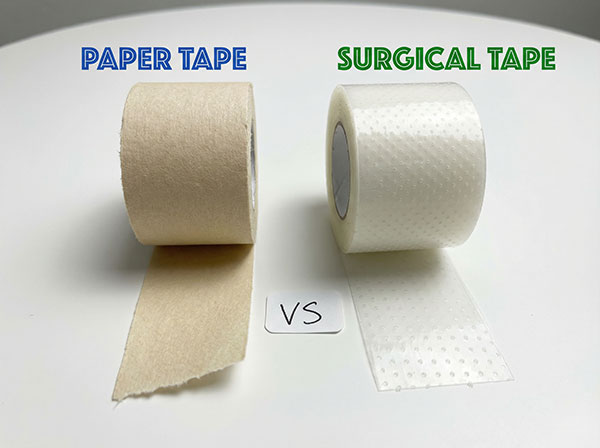
- Paper tape: Very light adhesion, suitable for minimal fixation
- Surgical tape: Ranges from gentle to strong, depending on material
Surgical tape is better suited for applications requiring reliable, longer-lasting fixation, such as IV lines or post-operative dressings.
- Paper tape: Best for short-term use
- Surgical tape: Designed for extended wear and higher movement
In hospital environments where patients are mobile or care spans multiple shifts, surgical tape provides more consistent performance.
Paper tape is limited in scope, while surgical tape supports multiple clinical applications, including:
- Wound dressing fixation
- IV and catheter securement
- Post-operative care
This versatility is why hospitals typically stock several surgical tape types rather than relying solely on paper tape.
- Paper tape: Opaque and less moisture resistant
- Some surgical tapes: Transparent and moisture resistant
Transparent surgical tape allows clinicians to monitor insertion sites without removing the tape, reducing unnecessary disruption.
| Feature | Paper Tape | Surgical Tape |
|---|---|---|
| Backing Material | Paper-based | Non-woven, PE film, or silk |
| Adhesion Level | Very gentle | Gentle to strong |
| Wear Duration | Short-term | Short to long-term |
| Moisture Resistance | Low | Varies by type |
| Transparency | No | Available (PE tape) |
| Clinical Use | Light fixation | Broad clinical applications |
| Product Examples | — | View Microporous Tape / View Transparent PE Tape |
Paper tape may be appropriate when:
- Fixation demands are minimal
- Tape is changed frequently
- Skin fragility is the primary concern
- Movement and moisture exposure are limited
It is commonly used in low-risk, short-duration scenarios.
Surgical tape is typically preferred when:
- Secure fixation is required
- Patients are mobile
- Moisture or longer wear time is expected
- Clinical monitoring is necessary
Different surgical tape materials are selected based on application needs, not convenience.
For example:
- Microporous surgical tape is often used for breathable, skin-friendly fixation
- Transparent PE surgical tape is selected when visibility and moisture resistance are important
Most hospitals do not choose one over the other exclusively. Instead, they:
- Match tape type to clinical purpose
- Standardize usage guidelines by department
- Balance skin safety with fixation reliability
This approach reduces complications while maintaining workflow efficiency.
Paper tape and surgical tape serve different roles in healthcare settings. While paper tape is suitable for light, short-term applications, surgical tape offers the performance range and reliability required for modern hospital care.
Understanding the difference ensures better clinical outcomes, improved efficiency, and more informed procurement decisions.

sign up for our newsletter to receive the latest news, exclusive offers, and other discount information.