+86-13950196535, 086-592-5566387
 enquiry@ticarehealth.com
We serve all people who pursue high quality and personal customization for healthy life all over the world .

Urine drainage bags are not all designed for the same clinical environment. Although their basic function is to collect urine from a urinary catheter, differences in capacity, configuration, measurement capability, mobility, and intended application make some drainage bags more suitable for particular patients and care settings than others.
The main types of urine drainage bags include bedside drainage bags, leg bags, metered urine drainage bags, pediatric drainage systems, and specialized systems used for continuous bladder irrigation (CBI). Understanding these categories provides a useful foundation for healthcare professionals, medical distributors, and procurement teams evaluating urinary drainage products.
The right category depends on factors such as patient mobility, expected urine output, the need for precise measurement, the patient's age and clinical condition, and whether the drainage system is being used for routine urinary collection or a specialized urological procedure.
Urine drainage bag types can be classified primarily according to their intended clinical use and system configuration.
| Drainage bag type | Primary purpose | Typical care setting | Key characteristic |
|---|---|---|---|
| Bedside drainage bag | Continuous urine collection for relatively stationary patients | Hospitals, postoperative care, long-term care | Larger collection capacity |
| Leg bag | Urine collection while supporting patient mobility | Ambulatory and home healthcare | Compact, wearable configuration |
| Metered urine drainage bag | More precise urine-output monitoring | ICU, surgery, critical care | Integrated measuring chamber |
| Pediatric urinary drainage system | Urinary drainage for children when catheter drainage is clinically indicated | Pediatric wards, surgery, specialized care | Smaller, pediatric-oriented configuration |
| CBI drainage system | Collection during continuous bladder irrigation | Urology and postoperative care | Designed for high-volume irrigation and drainage |
These categories describe the major functional groups rather than fixed universal specifications. Capacity, outlet configuration, tubing length, connectors, valves, and other features can vary by manufacturer and product model.
Different urine drainage bags exist because urinary drainage requirements change with the patient's mobility, treatment environment, monitoring needs, and clinical procedure.
A patient who remains in bed for extended periods generally has different collection requirements from a patient who is mobile during the day. Similarly, routine urine collection does not require the same configuration as intensive monitoring of hourly urine output, and drainage during continuous bladder irrigation requires a system designed for a different fluid-management process.
The drainage bag is also part of a larger urinary drainage system. For indwelling catheterization, infection-prevention guidance emphasizes maintaining a closed drainage system, unobstructed urine flow, and positioning the collection bag below bladder level.
For this reason, choosing a drainage bag should not be based on capacity alone. The overall configuration needs to be appropriate for the catheter, clinical application, monitoring requirements, and facility protocol.
A bedside drainage bag is a larger-capacity urine collection bag generally used when the patient is spending substantial time in bed or otherwise has limited mobility.
The bag is normally positioned beside the bed and connected to an indwelling urinary catheter through drainage tubing. A hanger or hook allows the bag to be secured to the bed frame or another suitable support while keeping the collection bag below bladder level.
Common characteristics may include a graduated scale, drainage outlet, catheter tubing, sampling port, anti-reflux mechanism, and hanging device. Exact configurations vary by product.
Bedside drainage bags are commonly associated with:
- Hospital inpatient care
- Intensive care
- Postoperative recovery
- Long-term catheter management
- Nursing and long-term care
- Home healthcare when a larger collection capacity is appropriate
Their main functional advantage is the ability to collect a relatively large volume without requiring the patient to carry the collection device.
A bedside configuration also makes the collected urine readily accessible for routine output monitoring and emptying according to clinical protocols.
A leg bag is a compact urinary drainage bag designed to support mobility. It is secured to the leg and can generally be concealed beneath clothing, making it suitable for patients who need to move around while using an indwelling catheter.
Compared with a larger bedside configuration, the emphasis of a leg bag is portability and discretion rather than maximum collection capacity.
Typical design elements may include:
- Compact collection chamber
- Flexible inlet tubing
- Leg straps or other securement
- Graduated markings
- Drainage outlet
- Anti-reflux features on applicable models
Leg bags are commonly encountered in home healthcare, rehabilitation, ambulatory care, and long-term catheter management.
However, changing between a large collection bag and a leg bag can affect the integrity of a closed drainage system. AHRQ notes that switching bags may require breaking the closed system, while CDC guidance recommends maintaining a closed drainage system following aseptic catheter insertion.
For that reason, the configuration and change procedure should follow the applicable clinical protocol and manufacturer's instructions rather than treating bag changes as a routine convenience.
A metered urine drainage bag is designed for situations in which urine output needs to be measured more precisely over defined intervals.
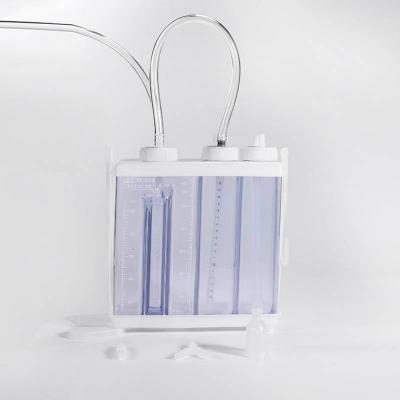
The system typically incorporates a calibrated measuring chamber positioned before the main collection bag. Urine can first accumulate in the measuring chamber, allowing healthcare professionals to determine output over a specified period before it passes into the larger collection reservoir.
This configuration is particularly useful when close urine-output monitoring forms part of patient management.
Metered drainage systems may be used in:
- Intensive care
- Perioperative care
- Critical care
- Major surgery
- Situations requiring close fluid-balance monitoring
AHRQ identifies the need for accurate hourly output measurement as one of the circumstances in which an indwelling urinary catheter may be clinically indicated in intensive care.
The value of a metered system is therefore not simply that it has graduation markings. Its defining characteristic is the integrated measurement chamber and drainage configuration, which supports more controlled urine-output monitoring.
Pediatric urinary drainage requires careful consideration of the patient's age, size, anatomy, expected urine output, and clinical condition.
A pediatric urinary drainage system connected to a catheter is different from a pediatric urine specimen collection bag. The latter is an adhesive pouch used to collect a voided urine specimen, particularly from infants and young children, and should not be confused with a catheter-connected drainage bag.
For catheterized pediatric patients, drainage configurations may use smaller collection volumes and appropriately scaled components. The exact specification depends on the patient's clinical needs and the medical device being used.
Pediatric urinary drainage systems may be relevant in:
- Pediatric surgery
- Pediatric urology
- Intensive pediatric care
- Selected inpatient catheterization cases
The key consideration is not simply choosing a smaller version of an adult bag. Tubing, connectors, capacity, securement, graduations, and overall system design should be appropriate for the intended pediatric application.
A CBI drainage system is designed for continuous bladder irrigation rather than routine urine collection alone.
Continuous bladder irrigation introduces irrigation fluid into the bladder through a suitable urinary catheter while fluid and bladder contents are continuously drained. The collection side therefore needs to accommodate a substantially different fluid-management process from a conventional urine drainage setup.
CBI systems are primarily associated with urological procedures and postoperative management where continuous irrigation is clinically indicated.
Depending on the system, relevant characteristics may include:
- High-capacity collection
- High-flow drainage pathways
- Appropriate tubing configuration
- Secure connections
- Graduated collection markings
- Outlet designs suitable for repeated drainage
CBI drainage systems should be evaluated as specialized urinary drainage configurations rather than simply as larger standard urine bags.
The main differences between drainage bag categories can be summarized by their intended function rather than by capacity alone.
| Type | Mobility | Measurement | Collection capacity | Typical application |
| Bedside drainage bag | Low | Standard graduated scale on applicable models | Medium to high | Hospital and long-term care |
| Leg bag | High | Standard graduated scale on applicable models | Low to medium | Ambulatory and home care |
| Metered drainage bag | Low | Enhanced measurement capability | Medium to high | ICU and critical care |
| Pediatric system | Variable | Depends on configuration | Smaller or pediatric-oriented | Pediatric care |
| CBI drainage system | Low | Primarily collection of irrigation output | High | Urological irrigation |
This table should be viewed as a classification guide. Individual products may have different capacities, valve arrangements, tubing lengths, connectors, and accessories.
Capacity is an important specification when evaluating urine drainage bags, but it should not be treated as the sole method of classification.
Common commercial configurations include smaller-capacity leg bags and larger bedside bags. For example, TICARE's current urine drainage bag family includes 1500 mL, 2000 mL, and selected 2600 mL configurations, demonstrating that capacity can vary within a single product family.
Other configuration variables may include:
Outlet design. Standard outlets, T-tap configurations, and other drainage mechanisms can affect how the collected urine is emptied.
Tubing length. Tubing dimensions need to provide sufficient reach while avoiding unnecessary loops or kinks that could interfere with drainage.
Connector configuration. The connection between the catheter and drainage tubing must be compatible with the intended system.
Measurement markings. Graduated scales can assist with routine volume assessment, while metered systems provide a more specialized measurement configuration.
Securement and hanging features. Bedside systems may use hooks or hangers, while leg bags require secure and appropriately positioned attachment.
Material and manufacturing quality. Medical-grade materials, reliable seals, consistent welds, and controlled production processes are important for disposable urinary drainage products.
The final specification should be determined by the intended application and applicable clinical and procurement requirements.
The type of drainage bag generally follows the clinical context rather than a simple preference for one product design.
For relatively stationary patients requiring continuous catheter drainage, a bedside drainage bag is commonly appropriate. When mobility and discreet wear are important considerations, a leg bag may be used when consistent with the overall catheter-management protocol.
When accurate urine-output monitoring is clinically important, a metered drainage system can provide a more suitable measurement configuration. Pediatric catheter drainage requires appropriately scaled equipment, while continuous bladder irrigation requires a specialized drainage configuration capable of handling irrigation output.
The choice should therefore be based on the patient's clinical requirements, catheter system, expected output, monitoring needs, and institutional procedures.
Although each category has a different purpose, several quality characteristics are relevant across urine drainage systems.
A well-designed drainage bag should support reliable urine flow while maintaining secure connections and minimizing the likelihood of leakage. Depending on the product configuration, features such as anti-reflux mechanisms, sampling ports, graduation markings, drainage outlets, and securement devices can contribute to functional performance.
For indwelling urinary catheter systems, maintaining a closed drainage system is an important infection-prevention principle. CDC guidance also recommends maintaining unobstructed urine flow, keeping the collection bag below bladder level, preventing the drainage spigot from contacting nonsterile surfaces, and avoiding routine replacement at fixed intervals unless clinically indicated.
For procurement teams, these clinical considerations should be evaluated alongside regulatory documentation, sterilization method, packaging integrity, material specifications, production consistency, and supply capability.
Selecting a drainage bag begins with identifying the clinical application.
For a patient who will remain primarily in bed, consider a bedside configuration with appropriate collection capacity and secure hanging. For an ambulatory patient, evaluate whether a leg bag configuration is appropriate within the care protocol.
When frequent or hourly urine-output assessment is required, consider a metered system rather than relying only on a conventional graduated bag. For pediatric applications, verify that the system is specifically appropriate for the intended patient population. When continuous bladder irrigation is prescribed, use a drainage configuration designed for that procedure rather than a standard collection bag.
For hospitals, distributors, and OEM projects, the evaluation should also include product specifications, available capacities, outlet configurations, tubing options, sterilization, packaging, regulatory documentation, quality controls, and customization requirements.
The objective is not to identify one universally superior drainage bag. It is to match the drainage system configuration to the intended clinical application.
The major categories include bedside drainage bags, leg bags, metered urine drainage bags, pediatric urinary drainage systems, and specialized drainage systems used for continuous bladder irrigation.
A bedside drainage bag is a relatively large urine collection bag designed for patients who have limited mobility or remain near a bed. It is typically secured to a suitable support and positioned below bladder level.
A leg bag is a compact urinary drainage bag designed to be worn on the leg. Its primary purpose is to support mobility and provide a more discreet collection configuration.
A metered urine drainage bag incorporates a calibrated measuring chamber that allows urine output to be assessed over defined intervals before the urine enters the larger collection reservoir.
No. A pediatric urine specimen collection bag is generally an adhesive pouch used to collect a voided urine specimen, while a pediatric catheter drainage system is connected to a urinary catheter for continuous drainage. The terms should not be used interchangeably.
A CBI drainage bag is part of a drainage configuration designed for continuous bladder irrigation. It collects the fluid drained from the bladder during the irrigation process and is designed for the higher-volume fluid management associated with the procedure.
There is no single universal capacity. Different drainage bag categories and product models use different configurations. Commercial products can range from smaller wearable leg bags to larger bedside systems, with specialized systems available for particular clinical applications.
Consider the patient's mobility, clinical indication, expected urine output, need for measurement, catheter compatibility, drainage configuration, capacity, securement, outlet design, material, sterilization, packaging, and applicable facility requirements.
No. Drainage bags can differ in capacity, outlet type, tubing length, connectors, sampling ports, anti-reflux mechanisms, measurement chambers, securement features, and other design elements. The appropriate configuration depends on the intended application.
TICARE provides a range of disposable urine drainage bag configurations for hospitals, clinics, long-term care facilities, distributors, and OEM projects. The current product family includes different capacities and outlet configurations, including standard outlet and T-tap options, with selected models offering additional hanging and premium configurations.
For healthcare distributors and medical brands, product selection can be adapted to project requirements such as capacity, outlet configuration, tubing, labeling, packaging, and private-label specifications, subject to technical feasibility and minimum order requirements.
Explore the complete TICARE urine drainage bag product family to review available configurations and discuss specifications, OEM requirements, and wholesale supply.

sign up for our newsletter to receive the latest news, exclusive offers, and other discount information.