0086-592-5566387
 enquiry@ticarehealth.com
We serve all people who pursue high quality and personal customization for healthy life all over the world .

Chronic Obstructive Pulmonary Disease (COPD) is one of the most common respiratory disorders worldwide and often requires controlled oxygen therapy. Delivering oxygen to COPD patients is not as simple as increasing oxygen flow; excessive oxygen can lead to carbon dioxide retention and respiratory depression.
For this reason, healthcare providers frequently use Venturi masks, a specialized oxygen delivery device that provides a precise and controlled oxygen concentration.
This article explains why Venturi masks are widely used in COPD treatment and how they support safe oxygen therapy in hospitals and clinical settings.
A Venturi mask is a high-flow oxygen delivery device designed to provide a fixed concentration of oxygen to patients.
Unlike simple oxygen masks, which deliver variable oxygen levels depending on breathing patterns, Venturi masks use air-entrainment valves to mix oxygen with room air in a controlled ratio.
This mechanism ensures that the patient receives a consistent fraction of inspired oxygen (FiO₂).
Typical Venturi masks deliver oxygen concentrations between 24% and 60%, depending on the adapter used.
COPD patients often rely on low oxygen levels to stimulate breathing.
If excessive oxygen is delivered, the body's respiratory drive can be suppressed, leading to:
- CO₂ retention
- respiratory acidosis
- reduced consciousness
- respiratory failure
Therefore, oxygen therapy for COPD patients must be carefully controlled.
Venturi masks allow healthcare professionals to maintain target oxygen saturation levels without causing oxygen toxicity.
The primary benefit of a Venturi mask is its ability to deliver a fixed oxygen concentration.
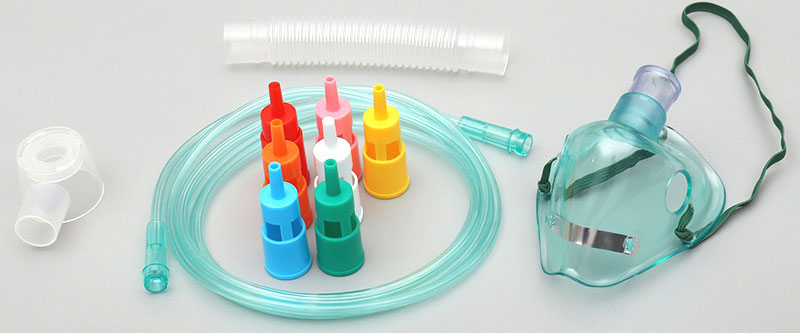
Each adapter is calibrated to provide a specific oxygen percentage.
This allows clinicians to match oxygen delivery precisely to the patient’s needs.
COPD patients are particularly vulnerable to hypercapnia.
Venturi masks reduce this risk by delivering controlled oxygen concentrations rather than excessive oxygen.
Because Venturi masks provide high total gas flow, the oxygen concentration remains stable even if the patient breathes rapidly.
Over-oxygenation can cause complications such as lung injury and respiratory depression.
Venturi masks help prevent hyperoxia by delivering controlled oxygen concentrations.
| Color | Oxygen | Flow |
|---|---|---|
| Blue | 24% | 2-4 L/min |
| White | 28% | 4-6 L/min |
| Yellow | 35% | 8-10 L/min |
| Red | 40% | 10-12 L/min |
| Green | 60% | 12-15 L/min |
Nasal cannulas deliver variable oxygen concentrations and are typically used for mild respiratory distress.
Venturi masks provide precise oxygen concentrations, making them more suitable for COPD patients.
Simple masks deliver oxygen concentrations around 40–60%, but the exact concentration may vary.
Venturi masks offer more precise control.
Non-rebreather masks deliver very high oxygen concentrations and are used mainly in emergency situations.
Venturi masks are better suited for controlled oxygen therapy.
Common clinical applications include:
- COPD exacerbations
- respiratory distress
- postoperative oxygen therapy
- emergency departments
- intensive care units
Hospitals typically select disposable Venturi masks that offer:
- accurate FiO₂ control
- clear color-coded adapters
- soft medical-grade materials
- reliable oxygen tubing connectors
TICARE supplies high-quality disposable oxygen masks and respiratory products for hospitals and medical distributors worldwide.
Our Venturi masks provide:
- precise oxygen delivery
- color-coded diluters
- comfortable patient design
- sterile medical-grade materials
Contact TICARE to learn more about bulk supply options for hospitals and distributors.

sign up for our newsletter to receive the latest news, exclusive offers, and other discount information.