0086-592-5566387
 enquiry@ticarehealth.com

We serve all people who pursue high quality and personal customization for healthy life all over the world .
Categories
Latest blog
Tags
By: TICARE Export Compliance Team
Tags: #OceanFreight #SupplyChainAfrica #MedicalSupplies #FlatPacked #SafetyBox #TICARE
(Introduction)
For medical consumables distributors and importers in Africa, ocean freight is often the single largest line item eating into your profit margins.
If you are currently importing pre-assembled paper safety boxes (sharps containers), you are faced with a harsh reality: you are paying premium freight rates to transport empty air.
Paper safety boxes are low-density items (high volume, low weight). When they are fully assembled at the Chinese factory, a standard 40HQ container can only hold a fraction of what it could if the boxes were transported efficiently.
In this article, we will break down the exact math of "Flat-Packed" packaging, address the common concerns regarding local assembly labor, and explain how to protect your shipment from the silent killer of African ports: extreme humidity.
Let’s look at the numbers. The most effective way to reduce your landed cost is to reduce your Cost Per Unit (CPU) in freight.
Take our best-selling 5L Paper Safety Box as an example. We pack them flat-packed at 100 pieces per master carton. The carton dimensions are 57.5 × 28 × 50 cm, which equals approximately 0.0805 CBM (Cubic Meters) per carton.
The Pre-Assembled Trap:
If those same 5L boxes were assembled and shipped, you would likely fit only 20-30 units per carton due to the trapped air inside the boxes. This means you would need 3 to 5 times more container space to ship the exact same number of boxes.
The Flat-Packed Advantage:
By shipping the boxes unassembled and nested tightly, you increase your container utilization by up to 400%.
If a 40HQ container can hold 10,000 pre-assembled boxes, that same container can hold 40,000 to 50,000 flat-packed boxes.
The Result: Your ocean freight cost per individual box is slashed by 70% to 80%. The space you save directly translates into higher profit margins or a more competitive bid price for your next tender.
The most common question we hear from African buyers is: "If the boxes are flat-packed, we have to pay local workers to assemble them. Doesn't that cancel out the freight savings?"
The short answer is: No. Not even close.
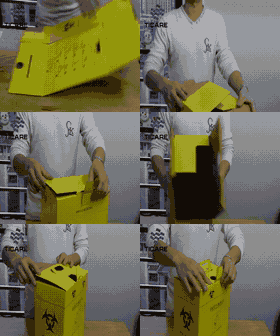
The 10-Second Self-Locking Design:
Our flat-packed safety boxes feature a heavy-duty, pre-glued self-locking mechanism. There is absolutely no need for tape, glue, or staplers. A warehouse worker can fold and lock a 5L box in under 15 seconds.
The Financial Calculation:
Even if you hire temporary labor in Lagos or Nairobi specifically to assemble these boxes, the local labor cost to assemble 10,000 boxes is negligible (often less than $50 USD depending on local wage laws).
Compare that to the thousands of dollars you save in ocean freight by flat-packing the shipment—the ROI is undeniable. You are trading pennies in local labor for massive savings in international logistics.
If freight costs are your first concern, moisture damage should be your second.
Importing into major African ports like Lagos (Apapa), Mombasa, or Durban presents a unique logistical challenge: extreme humidity and unpredictable customs clearance times (demurrage).
Standard corrugated cardboard acts like a sponge. If a container sits at the port for 30 to 45 days in a humid coastal climate, standard paper boxes will absorb moisture. They become soft, the puncture-resistance fails, and the handles tear when nurses try to carry them.
TICARE’s Moisture-Proof Protocol:
To ensure our safety boxes arrive in pristine, rigid condition, we use a dual-layer defense:
Surface Varnish / Film Lamination: The corrugated paperboard is treated with a moisture-resistant varnish. This repels ambient humidity and keeps the board rigid.
PE Inner Bag Packaging: Every master carton is lined with a heavy-duty Polyethylene (PE) inner bag before the flat-packed boxes are loaded, completely sealing them off from container condensation (container rain).
Choosing flat-packed paper safety boxes is not just a packaging preference; it is a fundamental supply chain strategy. It minimizes your CBM, maximizes your container utilization, and protects your investment from the elements.
At TICARE, we don't just manufacture WHO-standard safety boxes; we engineer our packaging to optimize your shipping costs.
Want to calculate exactly how much you can save?
Don't guess your container loading. Contact our logistics team today to get a customized loading plan for your next shipment to Africa.
Related Resources:
Preparing for a government tender? Read our Africa Tender Survival Guide: Avoiding Disqualification for Paper Safety Boxes.
Disclaimer: Ocean freight rates fluctuate based on global logistics and seasonal demand. The data provided in this article is for estimation purposes. Please consult your freight forwarder for exact shipping quotes.

sign up for our newsletter to receive the latest news, exclusive offers, and other discount information.