0086-592-5566387
 enquiry@ticarehealth.com
We serve all people who pursue high quality and personal customization for healthy life all over the world .
Categories
Latest blog
Tags
Over the past decade, respiratory care technology has evolved rapidly. Vibrating mesh nebulizers have gained widespread attention for their portability, reduced residual volume, and increasingly precise aerosol delivery. In many clinical discussions, they are often presented as the future of nebulization.
Yet inside hospitals, respiratory therapy departments, pediatric emergency units, and long-term care environments, Large Volume Ultrasonic Nebulizers (LVUNs) continue to play an important operational role.
This is not because healthcare systems are resistant to innovation. Rather, it reflects a reality that is often overlooked in product-focused discussions:
Hospitals do not evaluate respiratory equipment based on technical performance alone.
Clinical operations are shaped by staffing pressures, procurement budgets, workflow continuity, maintenance requirements, and the ability to scale care during periods of high patient demand. In many of these areas, large volume ultrasonic nebulizers continue to provide practical advantages that newer systems do not fully replace.
Large volume ultrasonic nebulizers were originally developed for sustained aerosol generation in environments where continuous respiratory support was required. Unlike portable or patient-oriented nebulizer systems, LVUN platforms are designed to support prolonged delivery workflows in institutional settings.
That distinction remains important today.
In high-volume respiratory environments, equipment is judged not only by aerosol efficiency, but also by operational predictability. Respiratory therapy departments often need systems that can integrate smoothly into established care protocols, support multiple treatment scenarios, and remain dependable during respiratory surges or staffing shortages.
This is one reason many hospitals continue using LVUN systems even while adopting newer mesh technologies in parallel.
Vibrating mesh nebulizers clearly offer advantages in several clinical situations. Their compact size, quiet operation, and improved medication delivery characteristics make them particularly useful for ambulatory care, portable therapy, and precision aerosol applications.
However, healthcare infrastructure rarely changes as quickly as device innovation.
Replacing an established respiratory platform involves more than purchasing new hardware. It may also require retraining staff, updating cleaning protocols, reorganizing inventory systems, modifying respiratory workflows, and increasing dependency on proprietary consumables or replacement components.
For large healthcare organizations, those operational considerations carry significant weight.
As a result, many institutions are not pursuing full replacement strategies. Instead, they are adopting hybrid respiratory models in which mesh nebulizers and LVUN systems serve different operational purposes.
One of the clearest reasons LVUN systems remain relevant is their role in continuous aerosol therapy.
In respiratory care environments such as pediatric emergency departments and intensive care units, clinicians may require sustained aerosol delivery over extended periods. This includes applications such as continuous bronchodilator administration, airway humidification, and prolonged respiratory support workflows.
In these situations, operational consistency often becomes more important than portability.
LVUN systems continue to offer advantages in:
- prolonged aerosol generation,
- high-output respiratory support,
- and established continuous therapy protocols.
For many hospitals, these systems remain dependable tools for managing routine high-demand respiratory workflows.
Discussions around nebulizer technology often focus heavily on clinical performance metrics. Procurement teams, however, typically evaluate a much broader set of operational variables.
The true cost of a respiratory platform includes:
- maintenance requirements,
- consumable dependency,
- equipment standardization,
- training burden,
- and replacement frequency.
This is where large volume ultrasonic nebulizers continue to maintain relevance, particularly in high-volume or budget-sensitive healthcare systems.
While mesh technologies may provide performance advantages in specific applications, LVUN systems are often perceived as more predictable from a long-term operational budgeting perspective. Their infrastructure requirements are generally familiar to respiratory departments, and many organizations already have established maintenance procedures and compatible inventories in place.
In large healthcare systems, maintaining workflow continuity can sometimes provide more value than pursuing incremental performance gains.
One of the least discussed—but most important—factors in healthcare operations is workflow stability.
Respiratory therapy departments function within highly coordinated clinical environments where consistency matters. Equipment changes can affect:
- staff training,
- cleaning procedures,
- treatment setup time,
- inventory management,
- and protocol standardization across departments.
Because of this, hospitals do not always replace established systems simply because newer technology becomes available.
Instead, healthcare organizations often prioritize solutions that:
- minimize operational disruption,
- reduce implementation complexity,
- and support predictable care delivery across large teams.
LVUN systems continue to fit well within these operational realities.
The pandemic reshaped how hospitals think about respiratory infrastructure.
Healthcare systems became acutely aware of the importance of equipment that could be deployed rapidly, standardized across departments, and supported during periods of supply-chain instability.
Large volume ultrasonic nebulizers benefited from this shift because they are often viewed as operationally familiar and relatively scalable. In many institutions, respiratory teams already understand how to deploy, maintain, and integrate these systems into emergency workflows.
That familiarity matters during periods of elevated patient volume.
The discussion is no longer only about which technology is newest. Increasingly, hospitals are evaluating which systems can continue functioning reliably under operational pressure.
One of the most important trends in modern respiratory care is the movement away from “single-technology thinking.”
Rather than replacing all legacy systems, many hospitals are building layered respiratory infrastructures that combine multiple aerosol delivery technologies.
In practice, this often means:
- mesh nebulizers are used where portability or precision delivery is prioritized,
- while LVUN systems remain in use for continuous, high-volume respiratory workflows.
This hybrid model reflects a broader shift in healthcare procurement strategy. Hospitals are increasingly selecting equipment based on operational fit within specific clinical scenarios rather than pursuing universal replacement.
That approach is likely to continue shaping respiratory care purchasing decisions over the next several years.
Large volume ultrasonic nebulizers are unlikely to dominate future respiratory innovation headlines. Mesh technologies and smart aerosol platforms will continue expanding, particularly in outpatient and precision-care environments.
However, that does not mean LVUN systems are disappearing.
Their continued use reflects something more fundamental about healthcare operations: reliability, scalability, workflow familiarity, and cost predictability remain critically important in clinical decision-making.
For many respiratory departments, the question is no longer whether one technology completely replaces another. Instead, the focus is shifting toward how different aerosol systems can work together across increasingly complex healthcare environments.
In that context, large volume ultrasonic nebulizers remain operationally valuable—not because they compete directly with every newer technology, but because they continue to perform effectively within the clinical and operational roles they were designed to support.
Healthcare providers and distributors increasingly require respiratory systems that balance:
- operational efficiency,
- scalable aerosol delivery,
- and long-term procurement stability.
At Ticare Health, we support respiratory care partners with professional aerosol therapy solutions designed for hospital, clinical, and institutional respiratory applications.
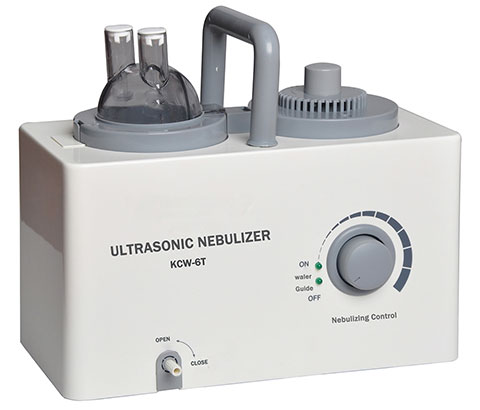
TICARE DUAL HEAD ULTRASONIC NEBULIZER MACHINE / TC-KCW-6T
Need Global Distribution Opportunities? Email:enquiry@ticarehealth.com

sign up for our newsletter to receive the latest news, exclusive offers, and other discount information.