0086-592-5566387
 enquiry@ticarehealth.com
We serve all people who pursue high quality and personal customization for healthy life all over the world .
Categories
Latest blog
Tags
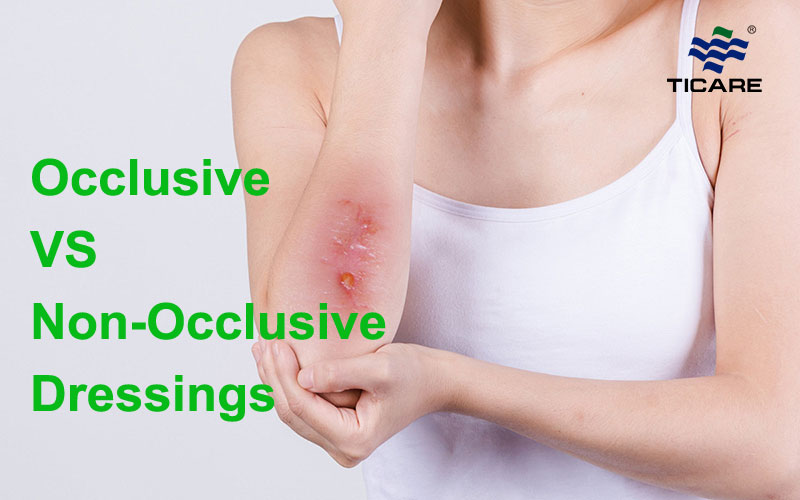 Occlusive and non-occlusive dressings are common classifications used in wound care product specifications. These terms describe how a dressing interacts with air and moisture at the wound surface rather than indicating clinical outcomes or treatment effectiveness.
Understanding the key differences between occlusive vs non-occlusive dressings helps procurement teams, distributors, and healthcare facilities evaluate wound care products based on barrier properties, breathability, wear characteristics, and workflow requirements. This article provides a specification-focused comparison designed to support informed product selection.
Occlusive dressings are designed to create a sealed or semi-sealed barrier over the wound surface. This barrier limits the exchange of air and moisture vapor between the wound and the external environment. Occlusive dressings are typically self-adhesive and remain securely in place without requiring secondary fixation.
Common examples of occlusive or semi-occlusive dressings include hydrocolloid dressings and polyurethane film dressings, which are widely included in professional wound care product ranges.
Non-occlusive dressings allow air to circulate freely between the wound and the surrounding environment. These dressings are generally more breathable and may absorb or allow drainage of wound exudate. Non-occlusive dressings often require secondary fixation, such as tape or bandages, to remain in place.
Typical non-occlusive dressing types include traditional gauze dressings and certain foam dressings, depending on their structure and design.
Occlusivity plays an important role in product specification and procurement decisions. The degree to which a dressing restricts airflow and moisture exchange influences:
- How moisture is contained or released
- Dressing stability during wear
- Frequency of dressing changes
- Storage and packaging requirements
- Compatibility with care environment protocols
For procurement teams, understanding occlusivity supports accurate product categorization and ensures consistency across wound care inventories.
The table below highlights the main functional differences between occlusive and non-occlusive dressings.
| Feature | Occlusive Dressings | Non-Occlusive Dressings |
|---|---|---|
| Airflow | Limited | High |
| Moisture Barrier | Strong | Minimal |
| Exudate Handling | Retains moisture | Absorbs or allows drainage |
| Adhesion | Often self-adhesive | Often requires fixation |
| Wear Time | Typically longer | Often shorter |
| Access for Monitoring | Requires removal | Easier access |
Occlusive dressings are designed to retain moisture beneath the dressing surface, creating a controlled environment. Non-occlusive dressings, by contrast, allow moisture vapor to escape and promote airflow.
These differing approaches to moisture management influence how dressings are stocked and selected across hospitals, clinics, and home care settings, depending on established care workflows.
Wear time is an important operational consideration in professional wound care environments. Occlusive dressings are often associated with longer wear duration, which may reduce the frequency of dressing changes. Non-occlusive dressings may require more frequent replacement, depending on absorption capacity and external exposure.
From a procurement perspective, dressing change frequency affects inventory planning, staff workload, and overall supply consumption.
Occlusive / Semi-Occlusive Dressings
- Hydrocolloid dressings
- Polyurethane (PU) film dressings
Non-Occlusive Dressings
- Gauze dressings
- Certain foam dressings
These categories are not exhaustive, and product classification may vary based on specific material construction.
When selecting wound dressings for professional use, procurement teams commonly consider:
- Facility standards and care protocols
- Product labeling and regulatory compliance
- Compatibility with existing wound care products
- Storage conditions and shelf life
- Consistency across supply chains
Understanding dressing classifications helps ensure appropriate product alignment within broader wound care systems.
Occlusive and non-occlusive dressings differ primarily in their interaction with air and moisture. Occlusive dressings limit airflow and retain moisture, while non-occlusive dressings allow breathability and easier access. These differences support distinct specification requirements rather than indicating clinical preference.
The comparison of occlusive vs non-occlusive dressings highlights how dressing classifications are used to describe functional properties rather than treatment outcomes. Each category offers characteristics suited to different procurement and workflow needs within professional wound care environments.
To explore a full range of wound care products, including hydrocolloid dressings, visit our wound care category for detailed product specifications and options.
Occlusive dressings limit airflow and moisture exchange, creating a sealed or semi-sealed barrier. Non-occlusive dressings allow air circulation and moisture evaporation. These classifications describe dressing behavior rather than clinical effectiveness.
Yes, hydrocolloid dressings are generally classified as occlusive or semi-occlusive because they form a moisture-retaining barrier and limit air exchange when applied to the wound surface.
Non-occlusive dressings are designed with open or absorbent structures that allow air and moisture vapor to pass through. This design supports ventilation and easier access to the wound area.
Occlusive dressings are often associated with longer wear duration due to their sealed design. Non-occlusive dressings may require more frequent changes depending on absorption capacity and environmental exposure.
Occlusivity affects dressing classification, storage requirements, wear time, and workflow planning. Understanding this distinction helps procurement teams select products that align with facility standards and wound care systems.

sign up for our newsletter to receive the latest news, exclusive offers, and other discount information.