0086-592-5566387
 enquiry@ticarehealth.com
We serve all people who pursue high quality and personal customization for healthy life all over the world .
Categories
Latest blog
Tags
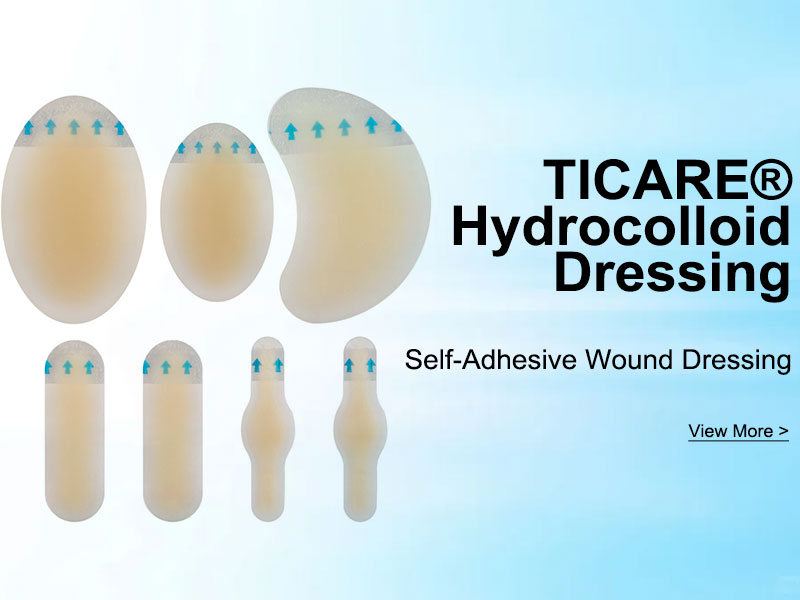
In modern wound care, maintaining an optimal healing environment is a key clinical consideration. Among advanced wound dressings, hydrocolloid dressings are widely recognized for their ability to create a controlled, moist environment that supports the natural wound healing process.
This article provides a clear, educational overview of what a hydrocolloid dressing is, how it works, and why it plays an important role in contemporary wound management. The content is intended for healthcare professionals, distributors, and medical procurement specialists seeking a better understanding of advanced wound care products.
A hydrocolloid dressing is a type of advanced wound dressing designed to interact with wound exudate and maintain a moist healing environment. It typically consists of an adhesive matrix containing hydrocolloid particles, combined with an outer protective layer.
Hydrocolloid dressings are classified as occlusive or semi-occlusive dressings, meaning they are designed to protect the wound from external contaminants while allowing limited moisture vapor transmission.
These dressings are commonly used in clinical and healthcare settings as part of modern wound care strategies.
Although designs may vary, most hydrocolloid wound dressings include the following functional components:
The adhesive layer contains hydrocolloid materials (such as carboxymethyl cellulose or similar compounds) that are designed to absorb wound exudate and transform into a soft gel upon contact with moisture.
As exudate is absorbed, the hydrocolloid particles swell and form a gel-like substance. This helps maintain a balanced moisture level at the wound interface.
The outer layer acts as a barrier against water, bacteria, and external contaminants while providing mechanical protection.
Together, these components allow the dressing to remain in place for extended periods under appropriate clinical conditions.
The working mechanism of a hydrocolloid dressing is based on controlled interaction with wound exudate.
When the dressing comes into contact with wound fluid:
- The hydrocolloid particles absorb moisture
- A soft gel forms at the wound interface
- The gel helps maintain a moist environment
This moist environment is widely recognized in wound care science as beneficial for supporting the body’s natural healing processes, including epithelialization and tissue regeneration, under professional supervision.
Importantly, hydrocolloid dressings are designed to support wound healing, not to actively treat or cure wounds.
The concept of moist wound healing has become a foundational principle in modern wound care. Compared with dry wound environments, controlled moisture levels may help:
- Protect newly forming tissue
- Reduce disruption during dressing changes
- Support natural cellular activity involved in healing
Hydrocolloid dressings are specifically designed to help maintain this environment by balancing absorption and moisture retention, making them a common consideration in advanced wound care protocols.
Traditional wound dressings, such as gauze, primarily function as protective coverings and often require frequent changes. In contrast, hydrocolloid dressings offer several structural and functional differences:
- Designed to remain in place for longer wear times
- Provide an occlusive or semi-occlusive barrier
- Interact with wound exudate rather than simply absorbing it
These differences explain why hydrocolloid dressings are often categorized as advanced wound dressings rather than basic coverings.
In clinical practice, hydrocolloid dressings are commonly considered by healthcare professionals for situations such as:
- Wounds with low to moderate exudate
- Skin protection and cushioning
- Early-stage pressure injury management
- Post-operative wound protection
The selection of any wound dressing depends on professional clinical assessment, wound condition, and care protocols.
- Helps maintain a moist wound environment
- Acts as a protective barrier against external contamination
- Designed for extended wear under appropriate conditions
- Flexible and conformable to body contours
- Not suitable for all wound types
- May not be appropriate for heavily exuding or infected wounds
- Requires clinical judgment for proper selection and monitoring
Understanding both benefits and limitations is essential for responsible and effective wound care management.
Hydrocolloid dressings play an important role in modern wound care by supporting a controlled, moist healing environment while protecting wounds from external factors. Their unique interaction with wound exudate distinguishes them from traditional dressings and makes them a widely used option in advanced wound management.
For medical institutions, distributors, and healthcare professionals, understanding how hydrocolloid dressings work is essential for informed product selection and clinical decision-making.
Learn more about Hydrocolloid Dressing solutions available at ticarehealth.com.
Hydrocolloid dressings are commonly used in clinical settings to help maintain a moist wound environment and protect wounds with low to moderate exudate under professional supervision.
A hydrocolloid dressing absorbs wound exudate and forms a gel at the wound interface, which helps maintain controlled moisture levels while protecting the wound from external contaminants.
Most hydrocolloid dressings feature an outer layer designed to resist water and external moisture, providing additional protection in appropriate clinical situations.
Wear time depends on wound condition, exudate level, and clinical assessment. Hydrocolloid dressings are generally designed for longer wear compared to traditional dressings.

sign up for our newsletter to receive the latest news, exclusive offers, and other discount information.